
Research and evidence from the field.
Our introductory video, an interactive product demo, white papers on where GenAI is taking go-to-market data, and a case study from a live engagement.
See the console your team would use.
Pick a seat, ask a question, and open the finished reports. It runs in your browser. No sign-up.
Choose sales rep, sales leader, product manager or marketing and the console shows only the analyses that fit that role. Past runs holds three finished reports, with company and people names anonymized. New requests run in a simulator, so nothing is sent anywhere.
- Annual sales-cycle reviewWhy revenue was lost, across a full year of calls.Sales leader
- Product blocker analysisProduct gaps priced in lost revenue and open pipeline.Product
- Rep development planA coaching plan built on specific moments from calls.Coaching
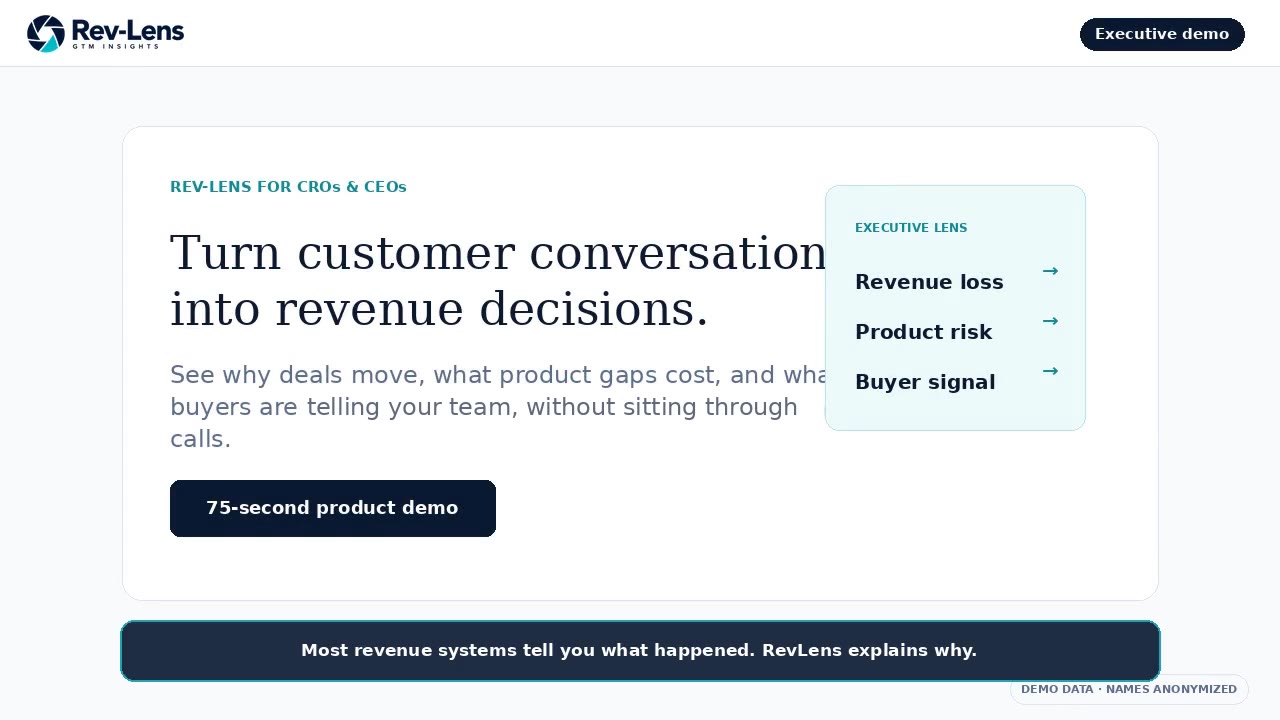 Watch the walkthrough 1:15
Reach Is Not Analysis
What MCP-connected agents can and cannot tell you about your go-to-market, and where a GTM data lake fits.
Through MCP, the agents in Gong, Salesforce and the rest of your stack can now pull data from other systems. That is real progress for deal-level work. But they retrieve data at the moment a question is asked, one deal at a time. This paper explains why questions about why you win and lose need every deal joined and counted, sets out five limits of analysis at question time, and lists the questions to ask your vendors.
The Model Layer
Why GTM data is moving inside the walls, and what revenue leaders should decide before it does.
Every GenAI GTM stack has three pieces: a data lake, a model layer and a library of agents. Most teams treat the model as a default. This paper makes the case that it is the next strategic decision, explains why large enterprises will move to private, dedicated models first, and sets out five moves that keep every option open.
Win-Rate Forensics
What the term means, what a finding has to contain, and how it differs from win-loss analysis.
Win-rate forensics explains your win rate from a census of your own deal records rather than a sample of buyer interviews. This page sets out the definition, the four tests every finding has to pass before it reaches a leadership team, the five sources the join depends on, a worked example with its denominator and counterfactual, and the cases where the method is the wrong tool.
- DenominatorOut of how many, and how many went the other way?
- EvidenceThe sentence it rests on, with a source and a date
- CounterfactualDoes the pattern also appear in the deals you won?
- OwnerA function that can change it and will call it theirs
How Rev-Lens Compares
Conversation intelligence, revenue intelligence, win-loss research and win-rate forensics were built for different questions.
Most teams evaluating us already pay for two or three of these. This page says plainly what each one is best at, where each one stops, and which question should send you to which. It is written to be useful even if the answer is that you need a win-loss research firm rather than an engagement with us.
- Conversation intelligenceOne call, one deal
- Revenue intelligenceThe pipeline, forward looking
- Win-loss researchOne buyer's recollection
- An LLM plus connectorsOne question, one answer
- Win-rate forensicsEvery deal in the period, counted
One feature. One year of calls. Under two hours.
Which opportunities involved a specific product capability, and what was blocking them? Account names changed. The numbers are real.
- Technical validationSE scoping calls to prove TLS and clustering behavior of the third-party detection engine.3 calls
- Budget approvalsLargest deals needed phased rollouts to get through finance.3 calls
- Cluster migration mechanicsExpanding without breaking the policy namespace.2 calls
Bring the one question your stack can't answer.
A 30-minute call. We'll check whether your data can support the question. If it can't, we'll say so.
- What you'll get: a yes or no on feasibility, and the sources it needs
- What it won't be: a demo, a license, a platform change
- Who you'll talk to: the founder who runs the analysis